

Description
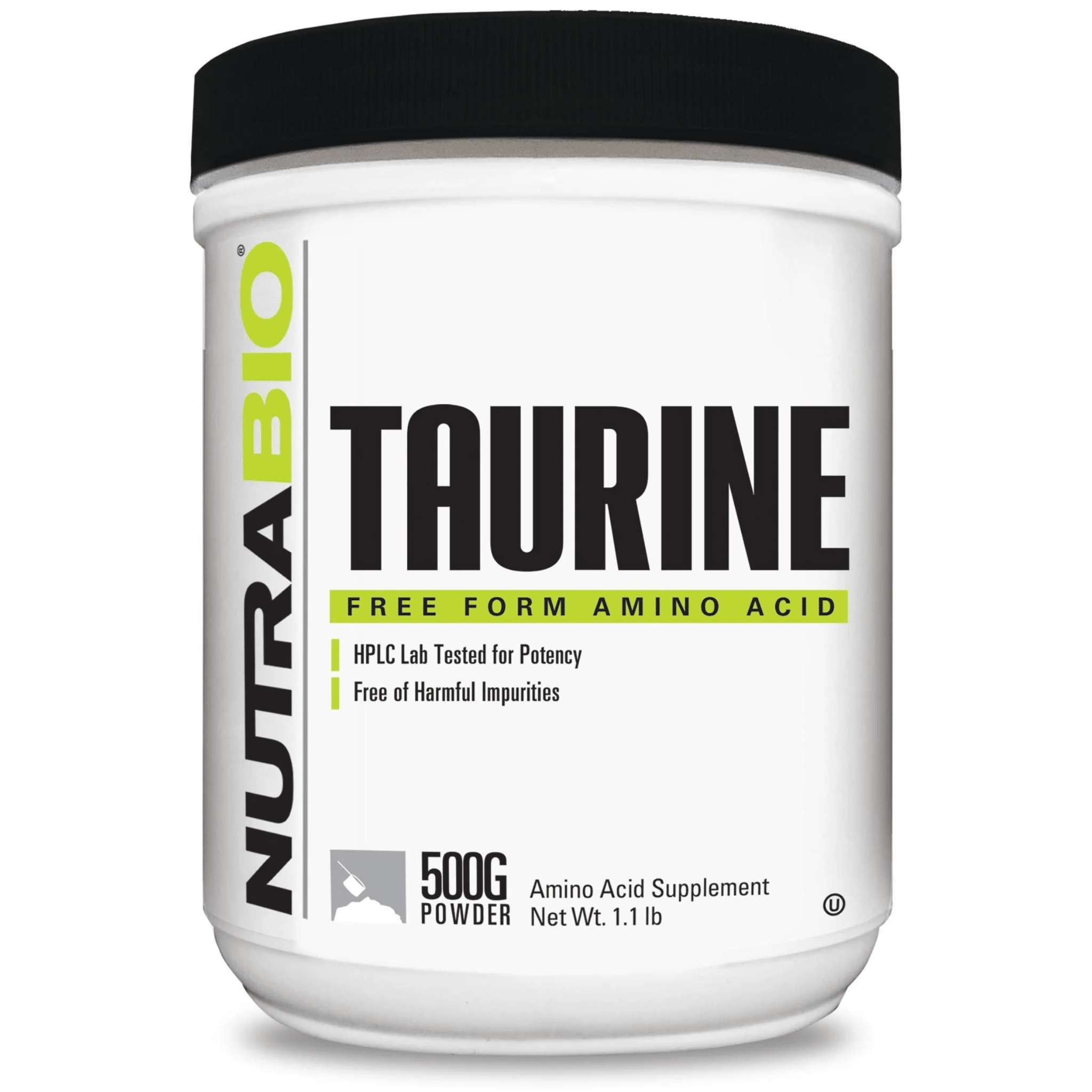
NutraBio Taurine
Pure free-form taurine with no fillers, sweeteners or excipients. Unflavoured, 500g.
Taurine is not a stimulant — and the energy drink association is backwards
Almost everyone assumes taurine is the reason energy drinks feel stimulating. It is close to the opposite.
Taurine is an inhibitory amino acid. It interacts with GABA receptors — the same system involved in calming neural activity — and it is included in energy drinks partly to take the edge off caffeine, not to add to it.
If anything, taurine smooths the jitter. Which makes the "taurine equals energy" assumption one of the more persistent bits of folklore in this industry.
What it actually does
Taurine is genuinely one of the more interesting and underrated ingredients on our shelf, with several distinct mechanisms:
- Cell volumisation. Taurine is an osmolyte — it draws water into muscle cells. That contributes to fullness and, more importantly, a well-hydrated cell is a better environment for protein synthesis
- Calcium handling. This is the interesting one. Taurine modulates calcium release inside muscle fibres, and calcium release is what triggers contraction. That is the mechanism behind research showing improved force output
- Antioxidant activity during exercise, which is relevant to soreness and recovery
- Cramp reduction. Taurine deficiency is linked to cramping, and it works alongside magnesium and electrolytes rather than duplicating them
- Cardiac and neurological function. Taurine is highly concentrated in heart tissue and the retina
The endurance evidence is reasonable — several studies report improved time-to-exhaustion at doses of 1 to 3g taken an hour or so before exercise.
Why it belongs in a pre-workout — and why yours might be underdosed
Most pre-workouts include taurine at 1 to 2g. That is a working dose.
But taurine pairs with caffeine for a specific reason that is worth knowing if you build your own stack: caffeine is a vasoconstrictor and a nervous-system stimulant, and taurine's inhibitory action moderates the resulting jitter without blunting the alertness. It does a similar job to L-theanine, by a different route.
If you find high-stimulant pre-workouts leave you edgy, adding taurine is one of the cheapest fixes available.
Specs
| Taurine | Pure, free form |
| Other ingredients | None |
| Size | 500g |
| Flavour | Unflavoured |
| Manufacture | NutraBio's own facility, USA |
| Label | Fully disclosed |
500g at 1–3g per serving is an enormous number of servings — well over a hundred even at the top of the range. Single-ingredient powders are dramatically cheaper per gram than the same active inside a flavoured formula.
Taurine is very nearly tasteless, which is unusual for a free-form amino acid and makes it the easiest of these to mix into anything.
A note for vegans
Taurine is found almost exclusively in animal foods — meat, fish and shellfish are the main dietary sources. Plant-based eaters have consistently lower plasma taurine levels, and while your body can synthesise some from cysteine and methionine, that capacity is limited.
That makes taurine one of the more sensible supplements for anyone eating plant-based, alongside creatine, which has the same dietary pattern. The taurine used here is synthetic rather than animal-derived.
How to take it
- 1 to 3 grams daily. Most research sits in that range.
- Around 60 minutes before training if you want the performance effect — taurine takes longer to peak than most.
- Any time otherwise. It is not a stimulant, so evening use is fine.
- Mixes into anything — effectively tasteless.
- Pair it with caffeine if you find stimulants leave you jittery.
- Check your pre-workout first — many already contain 1–2g.
Who this is for
- Anyone who finds high-stimulant pre-workouts leave them edgy
- People who cramp during training
- Endurance athletes — the time-to-exhaustion research is the strongest evidence taurine has
- Vegans and vegetarians, who have measurably lower baseline levels
- Anyone building their own pre-workout from single ingredients
- People who want a genuinely cheap active rather than paying for flavouring
Who this is not for
If you are expecting energy, this is the wrong assumption entirely — taurine is inhibitory, not stimulating.
If your pre-workout already contains 1–2g, adding more has diminishing returns.
If you eat plenty of meat and fish, your baseline is likely already reasonable.
Speak to your doctor first if you take medication for blood pressure or have a cardiac condition — taurine is active in heart tissue.
Not for anyone under 18, pregnant or nursing.
Stack it with: citrulline and beta-alanine for a genuinely complete stimulant-free pre-workout at a fraction of the cost of a branded tub.
Frequently asked questions
Is taurine a stimulant?
No — it is inhibitory, interacting with GABA receptors. It is in energy drinks partly to soften caffeine's edge, not to add to it.
How much should I take?
1 to 3 grams daily, which covers the researched range.
When should I take it?
About 60 minutes before training for performance effects, since it peaks slowly. Any time otherwise — it will not affect sleep.
Will it help with cramping?
Possibly. Taurine deficiency is linked to cramping, and it works alongside magnesium and electrolytes rather than replacing them.
Does it taste of anything?
Very nearly nothing, which is unusual for a free-form amino acid.
Should vegans take it?
It is worth considering. Taurine comes almost entirely from animal foods, and plant-based eaters have measurably lower plasma levels. The taurine here is synthetic, not animal-derived.
Can I take it with caffeine?
Yes, and that is one of its better uses — it moderates the jitter without blunting alertness.
Is it already in my pre-workout?
Very likely, at 1 to 2g. Check the label before adding more.
You may also like
Recently viewed
- Opens in a new window.