
Description
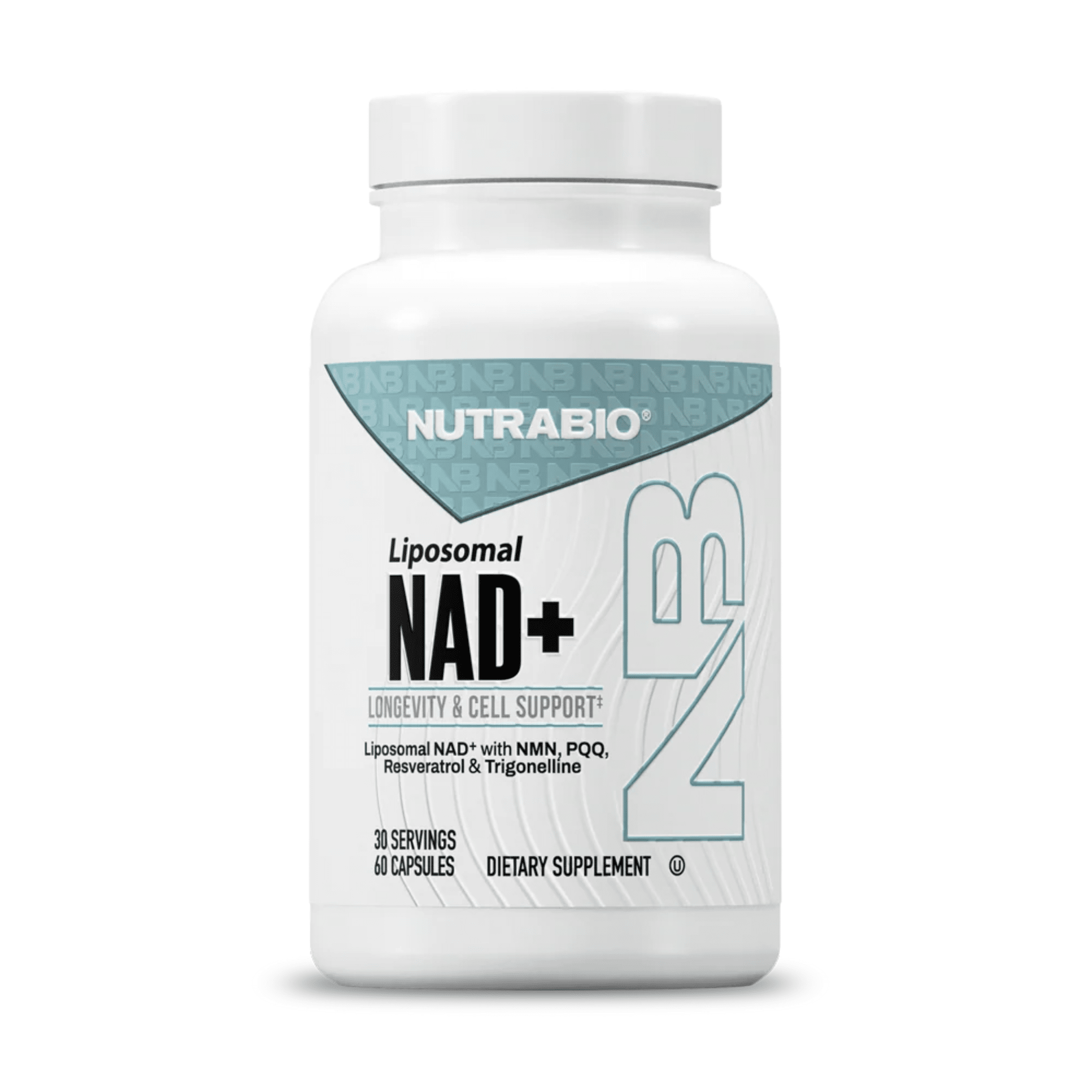
NutraBio Liposomal NAD+
NAD+ delivered in liposomal form, fully disclosed with no proprietary blends.
What NAD+ is, and why it gets so much attention
NAD+ (nicotinamide adenine dinucleotide) is arguably the single most important coenzyme in your metabolism. That is not an exaggeration — it participates in hundreds of reactions.
Its central role is carrying electrons. Nearly every step that extracts energy from food — glycolysis, the Krebs cycle, fatty acid oxidation — hands electrons to NAD+, which delivers them to the electron transport chain where ATP is made. No NAD+, no energy production.
And it does a second job that explains the interest in ageing: NAD+ is consumed as a substrate by two enzyme families — sirtuins, involved in cellular stress responses and metabolic regulation, and PARPs, which repair DNA damage.
Those enzymes do not merely use NAD+ as a helper — they consume it. So DNA repair and cellular maintenance genuinely draw down your NAD+ pool.
NAD+ levels decline substantially with age. That decline is well documented, and it is the observation the entire category rests on.
⚠ Why the delivery method is the whole question
Here is the problem NAD+ supplements have to solve, and it is a real one.
NAD+ is a large molecule, and large molecules are poorly absorbed intact. Taken orally in standard form, NAD+ is substantially broken down in digestion before it reaches circulation — much like the glutathione problem we describe elsewhere.
The industry's two answers:
- Precursors. Supply something smaller that your body converts into NAD+ — nicotinamide riboside (NR) or nicotinamide mononucleotide (NMN). This is the route with the most published human research
- Liposomal delivery. Encase the NAD+ in phospholipid vesicles — essentially tiny fat bubbles similar in composition to your own cell membranes — to protect it through digestion and improve uptake
Liposomal encapsulation is a genuine pharmaceutical technology, used in medicine for exactly this problem. The reasoning here is sound.
The honest caveat: liposomal quality varies enormously between manufacturers, and "liposomal" on a label is not a regulated term. How much intact NAD+ actually reaches circulation from any given oral liposomal product is not well established in published human data.
Our honest read on the evidence
We would rather you bought this with clear eyes.
What is well established: NAD+'s biological importance, and that levels decline with age. Neither is in dispute.
What is less established:
- Whether raising NAD+ through supplementation produces meaningful clinical outcomes in healthy people. Precursor trials have reliably shown blood NAD+ can be raised — but demonstrating that this translates into measurable improvements in energy, performance or ageing markers has proven considerably harder
- How much oral liposomal NAD+ is absorbed intact, compared with the better-studied precursor route
So: genuinely interesting biology, real mechanism, and an evidence base that is still developing. This is a reasonable thing to try if the area interests you and you have the fundamentals in place. It is not a proven intervention, and anyone selling it as an anti-ageing certainty is ahead of the science.
Our staff earn no commission, so nobody here benefits from framing it more confidently than that.
Specs
| NAD+ | Liposomal delivery |
| Label | Fully disclosed, no proprietary blends |
| Testing | Third-party tested, published at checkmysupps.com |
| Stimulants | None |
How to take it
- Follow the label — liposomal products have their own dosing logic and are not comparable gram for gram with standard forms.
- On an empty stomach generally suits liposomal delivery, since food can disrupt the vesicles.
- Morning. NAD+ is involved in energy metabolism and follows a daily rhythm, so earlier fits better.
- Consistently. Any effect here is cumulative rather than acute.
- Alongside the fundamentals, not instead of them. Sleep, training and food influence NAD+ metabolism considerably.
Worth knowing: exercise raises NAD+ on its own
This is a genuinely interesting point and we would rather mention it than not.
Exercise increases NAD+ levels and activates the same sirtuin pathways that NAD+ supplementation targets. Caloric restriction and fasting do likewise.
So if you train regularly, you are already doing the best-evidenced thing available for NAD+. That does not make supplementation pointless — but it does mean the marginal value is smaller for an active person than the marketing implies, and considerably smaller than for someone sedentary.
Who this is for
- Older adults interested in the age-related decline, which is the clearest rationale
- Anyone who follows this research area and wants to try it with realistic expectations
- People who already have training, sleep and nutrition in order and want to experiment at the margins
- Anyone who wants a liposomal option rather than a precursor
Who this is not for
Anyone expecting a noticeable energy effect. This is not a stimulant, and the acute experience is generally nothing.
Anyone on a tight supplement budget. Creatine, protein, vitamin D and sleep deliver far more per pound, with vastly more evidence.
Anyone wanting the most-researched route — the precursor forms NR and NMN have a larger published human literature than oral NAD+ itself.
Anyone with a medical condition or on medication, without speaking to a doctor. NAD+ metabolism intersects with several pathways.
Not for anyone under 18, pregnant or nursing.
Stack it with: nothing needed. If cellular energy is the interest, CoQ10 works in the same mitochondrial system through a different mechanism and has a longer research history.
Frequently asked questions
What is NAD+?
A coenzyme central to energy metabolism — it carries the electrons extracted from food to the electron transport chain where ATP is made. It is also consumed by sirtuins and DNA repair enzymes.
Why does it decline with age?
The decline is well documented, and is thought to reflect both reduced synthesis and increased consumption by repair enzymes over time.
Why liposomal?
NAD+ is a large molecule and is largely broken down in digestion. Liposomal encapsulation protects it through the gut — a genuine pharmaceutical technology used for exactly this problem.
Is it better than NMN or NR?
Not established. The precursor forms have a larger published human research base; liposomal NAD+ has a sound rationale but less data.
Will I feel more energetic?
Probably not acutely. It is not a stimulant, and any effect is cumulative.
Is the evidence strong?
NAD+'s importance and its age-related decline are well established. Whether supplementing it produces meaningful outcomes in healthy people is still developing.
Does exercise affect NAD+?
Yes — exercise raises NAD+ and activates the same sirtuin pathways. If you train regularly you are already doing the best-evidenced thing for it.
When should I take it?
Morning, on an empty stomach, consistently.
You may also like
Recently viewed
- Opens in a new window.