

Description
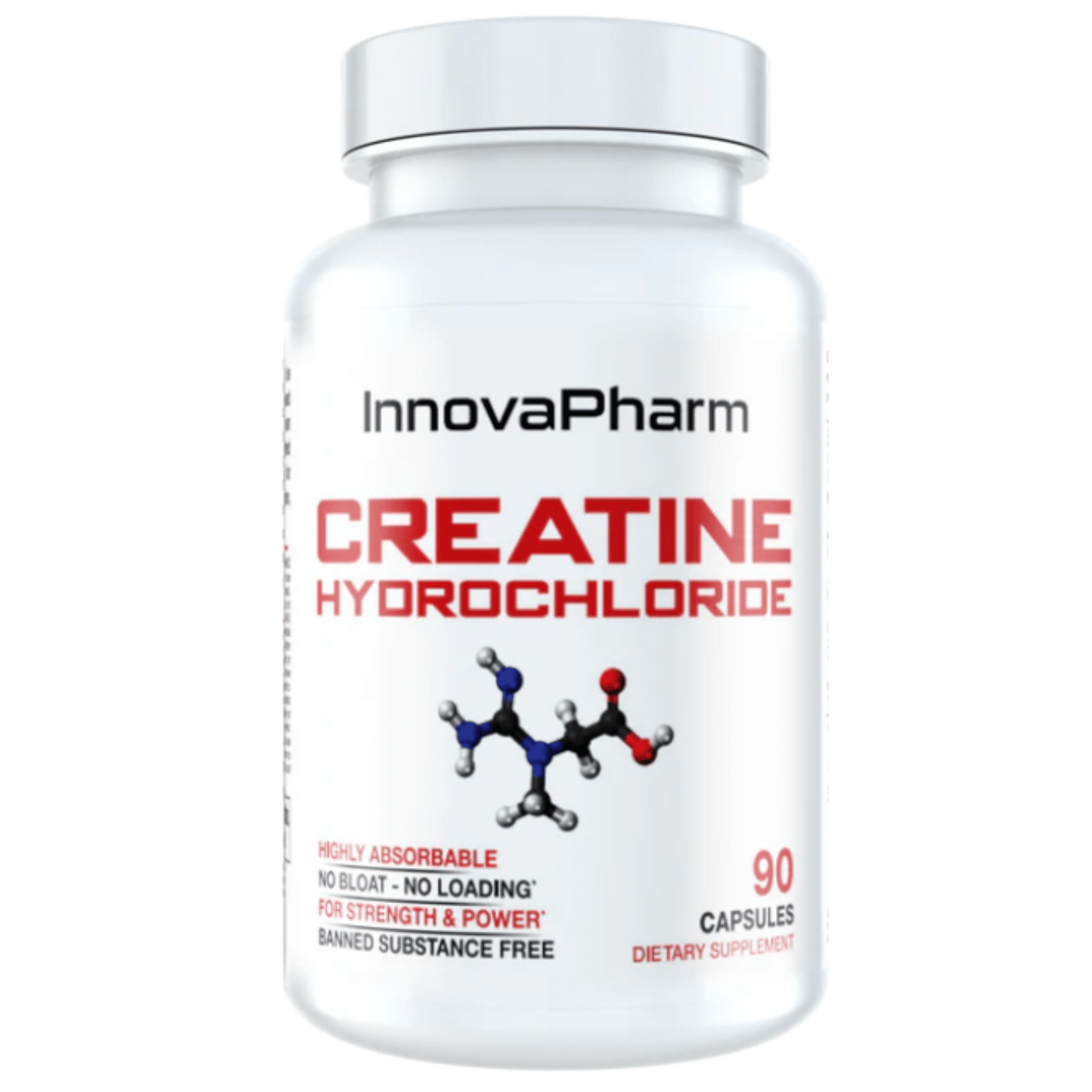
InnovaPharm Creatine HCL
Creatine hydrochloride — creatine bound to hydrochloric acid — in a concentrated, highly soluble form.
The honest comparison with monohydrate
We sell both, so we have no reason to favour either. Here is the fair picture.
Creatine monohydrate is the most researched sports supplement in existence. Hundreds of studies, decades of use, and a consistent effect on strength, power and lean mass. Every alternative form is measured against it.
Creatine HCl's genuine advantage is solubility. Binding creatine to hydrochloric acid produces a form that dissolves far more readily in water — dramatically so, and that is easy to observe for yourself.
What that solubility does and does not mean:
| Does mean | It dissolves cleanly, with no grit and no settling at the bottom of the shaker |
| Does mean | Less undissolved creatine sitting in the gut, which is the usual cause of bloating and stomach discomfort |
| Does not mean | Better absorption into muscle, or better results |
That last row is the important one. Solubility in a glass and uptake into muscle are different things, and the head-to-head research comparing HCl with monohydrate has not shown HCl to be superior for strength or muscle creatine content.
So the honest position: buy creatine HCl for tolerance, not for superiority. If monohydrate causes you bloating or stomach upset, this genuinely solves that problem, and a form you take consistently beats a better-researched form sitting unused. If monohydrate suits you fine, stick with it — it costs less and has far more evidence behind it.
⚠ On the smaller-dose claim
Creatine HCl is frequently sold with the argument that its superior solubility means you need considerably less — sometimes as little as a gram or two against monohydrate's 5g.
That claim is not well supported. Muscle creatine saturation is what produces the effect, and saturation depends on total creatine delivered rather than on how readily the powder dissolved.
Our practical advice: follow the label, but do not assume a small dose is doing the same job as 5g of monohydrate simply because it dissolves better. If in doubt, the evidence supports getting a full daily creatine intake regardless of form.
How creatine actually works
Worth having straight, because it explains why timing matters so little.
Creatine is stored in muscle as phosphocreatine, which donates a phosphate group to regenerate ATP during short, intense efforts. That is why the effect shows up in heavy sets, sprints and repeated maximal efforts rather than in endurance work.
It works by saturation. You are filling a reservoir, and once full it stays full with a daily maintenance intake. Which means:
- Timing is irrelevant. Before training, after training, with breakfast — it makes no meaningful difference
- Rest days count exactly as much as training days. This is the most common mistake
- Loading is optional. A loading phase fills the reservoir faster, but daily intake reaches the same endpoint within three to four weeks without the stomach upset loading can cause
- Cycling is unnecessary. There is no evidence that continuous use downregulates anything
Specs
| Creatine | Creatine hydrochloride |
| Solubility | Substantially higher than monohydrate |
| Loading phase | Not required |
| Label | Fully disclosed, no proprietary blends |
⚠ One practical note on taste: creatine HCl is noticeably sour, because it is an acid salt. Unflavoured versions are sharp in plain water — mix it into something flavoured, or expect a tang.
Our creatine range
| NutraBio Creatine | 5g PharmaPure monohydrate | Best evidence, best value |
| Nutristat Creapure | 5g Creapure | Highest-grade raw material |
| InnovaPharm Creatine HCl | Creatine hydrochloride | For anyone who bloats on monohydrate |
| TruCreatine Capsules | 3g Creapure, capsules | No mixing, travel-friendly |
Start with monohydrate. It is cheaper and better evidenced. Come to HCl if monohydrate does not agree with you — that is a real reason, and this is a real solution to it.
How to take it
- Follow the label, once daily.
- Every day, including rest days. Saturation is the mechanism.
- Any time of day. Timing genuinely does not matter.
- Mix into something flavoured — it is sour on its own.
- Drink enough water. Creatine draws water into muscle cells.
- No loading, no cycling.
Who this is for
- Anyone who gets bloating or stomach upset from monohydrate — the clearest reason to choose it
- People who dislike gritty, poorly-dissolving powders
- Anyone who has abandoned creatine before because of how it sat
- People who want a smaller powder volume
Who this is not for
Anyone who tolerates monohydrate perfectly well. Stick with it — cheaper, and far more evidence.
Anyone expecting better results than monohydrate. The head-to-head research does not support that.
Anyone who dislikes sour drinks, in the unflavoured version.
One thing worth knowing about bloodwork: creatine can raise serum creatinine, a marker used to estimate kidney function. That is a supplementation artefact rather than damage — tell your doctor you take creatine before any blood panel.
Not for anyone under 18, pregnant or nursing. Speak to your doctor first if you have a kidney condition.
Stack it with: anything. Creatine is stimulant-free and conflicts with nothing.
Frequently asked questions
Is creatine HCl better than monohydrate?
Not for results. It dissolves far better, which reduces bloating and stomach discomfort — but head-to-head research has not shown superiority for strength or muscle creatine content.
Do I need a smaller dose?
The smaller-dose claim is not well supported. Saturation depends on total creatine delivered, not on how readily the powder dissolved. Follow the label rather than assuming less does the same job.
Why does it taste sour?
It is an acid salt — creatine bound to hydrochloric acid. Mix it into something flavoured.
Do I need to load?
No. Daily intake reaches the same saturation within three to four weeks, without the stomach upset loading can cause.
Should I take it on rest days?
Yes. Creatine works by saturation, so rest days count exactly as much.
Does timing matter?
No. Before, after or unrelated to training makes no meaningful difference.
Should I switch from monohydrate?
Only if monohydrate causes you bloating or discomfort. Otherwise monohydrate is cheaper and better evidenced.
Will it affect my bloodwork?
It can raise serum creatinine, which is used to estimate kidney function. That is an artefact of supplementation — tell your doctor before a blood panel.
Workouts just aren't the same without it. The capsules are great too. Easier to travel with and can be taken any time.
You may also like
Recently viewed
- Opens in a new window.